Security engines
Runtime threat detection
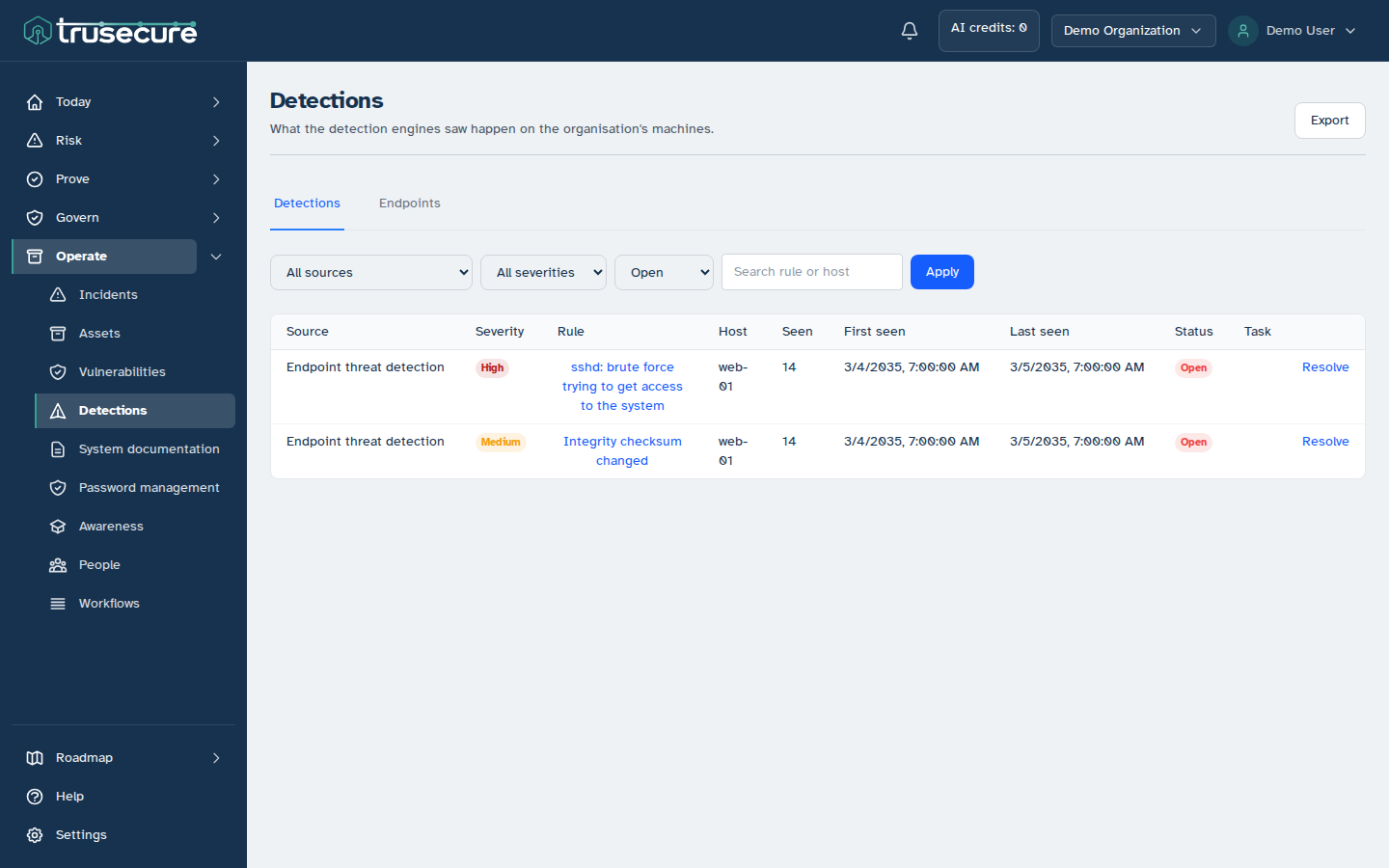
Your IT puts a sensor on each host it watches, and one forwarder sends every alert to TruSecure. Each alert becomes one detection, with the host matched to your asset register by name and never guessed.
- priorities a sensor reports
8
From the lowest to the highest.
- detection per rule, host and container
1
Each later alert counts on the same one.
- forwarder for every sensor
1
One forwarder sends every alert on.
What TruSecure does
Your servers watched, and every alert kept as a detection
The engine takes the alerts your sensors send and keeps them in your organisation's own rows. One detection stands for one rule on one host and container. What the alert said is kept encrypted beside it, and nowhere else.
The run
What happens when an alert arrives
The alerts come to TruSecure on their own, pushed by the forwarder, and a run only checks that the sensor still answers.
| Step | What happens |
|---|---|
| Prepares the tool | It asks the sensor for its version, and writes nothing to the sensor or the forwarder. They run the tool's own default rules, and the lowest priority you keep is set on your policy page. |
| Reads | A run checks that the sensor still answers and reads nothing else. The alerts arrive on their own, pushed by the forwarder to your inbound address under the secret TruSecure issued. |
| Holds the result | Each alert becomes one detection per rule, host and container. The first opens it and counts one sighting, each next one adds to its count and moves its last sighting forward. A detection a person resolved opens again when it alerts again. |
| Records the run | A pushed alert is not a run. Nothing is started, stopped or stamped on your connection, and the detection stands on the shared list of detections. |
Questions
Questions we are asked about runtime alerts
- Who installs the sensor?
- Your own IT does. The sensor goes on each host you want watched, or the official chart on a Kubernetes cluster, and one forwarder sends every alert on to TruSecure.
- What is kept of an alert?
- Its sentence, every field it carried, the command lines and the account names among them, and its tags. All of it is kept encrypted beside the detection, and nowhere else.
- What if the sensor will not answer?
- The run tells you what went wrong in one sentence, and the detections you had are left alone. The health check reads the sensor's own answer about itself.
- How is a host matched to my assets?
- By name, without regard to case, and only against a machine, a virtual machine, a cloud resource, a network device or a service that is still seen. No match or several is never a guess.
Open source
This capability runs Falco, an open-source project released under the Apache-2.0 licence.
Start
See what your servers report
Tell us which hosts you would watch. We show you what a sensor reports and what each alert would leave on the record.