The board
The board you can read, and vote on
250+ pieces of work, each with its own reference. Every one of them is in the product. You read the board, you ask for what is missing, and you vote once on each thing. Nothing on it is hidden from the people who pay for it.
- entries on the board
250+
Every one of them is in the product, with its own reference.
- of them you can ask for
200+
The rest is our own engineering, on the same board.
- vote each, then it is counted
1
Sign in, ask for things, vote once each, and comment.
In the product
What the product does
These are on the board and in the product. Each one has its own reference and shipped with a release note. The reference stays the same for years, so you can ask us about it later.
| Reference | What it does | State |
|---|---|---|
| FR-99 | An audit trail that cannot be rewritten, even by us | shipped |
| FR-132 | Run a compliance audit inside the product, with the auditor signed in | shipped |
| FR-94 | A risk appetite the board sets per category, approved and recorded | shipped |
| FR-123 | A daily brief of what needs your attention | shipped |
| FR-53 | Incident notification deadlines, per regulation | shipped |
| FR-146 | Answer your customers' security questionnaires from your own compliance record | shipped |
| FR-148 | Evidence checked before the auditor sees it | shipped |
| FR-231 | Controls that complete themselves | shipped |
| FR-331 | AI penetration testing of your websites, only where you approved it | shipped |
| FR-332 | People can ask about their personal data from your own website | shipped |
| FR-343 | A vCISO that works beside you, raising and following the work | shipped |
| FR-76 | One pane of glass for threat management, not a list of feed rows | shipped |
| FR-141 | A first risk register proposed from what your connected systems report | shipped |
| FR-173 | Look up any CVE, hear when one changes, and take a finding into work | shipped |
| FR-234 | Evidence and meetings from where you already keep them | shipped |
| FR-249 | Every control in the application either works, or carries the reason it does not | shipped |
Your part in it
How the board works
The board is not a notice board. You use it, and what you use is what gets built next.
- You read the board. Every entry is on it, with its own reference.
- You ask for what is missing. Your request is raised and given a reference of its own.
- You vote once on each thing, so the order of the work follows what you need.
- You comment on any entry, and the answer stays on the entry itself.
- You read the release notes for what shipped, with the date it shipped on.
The vCISO
A vCISO that works beside you
Your organisation gets a colleague in the application. It watches what changes in your connected tools, your meetings, new threats and your documents. It raises the risks and incidents that follow in plain business words. It writes a concrete plan for each, and follows that plan until it is done.
- It tells you what it did and why, every time.
- It asks you for what only a person may decide. It never approves, accepts or closes anything.
- Anything it did can be taken back in one press.
- You choose what it may do by itself and what it has to ask first.
The release notes
What changed, and when
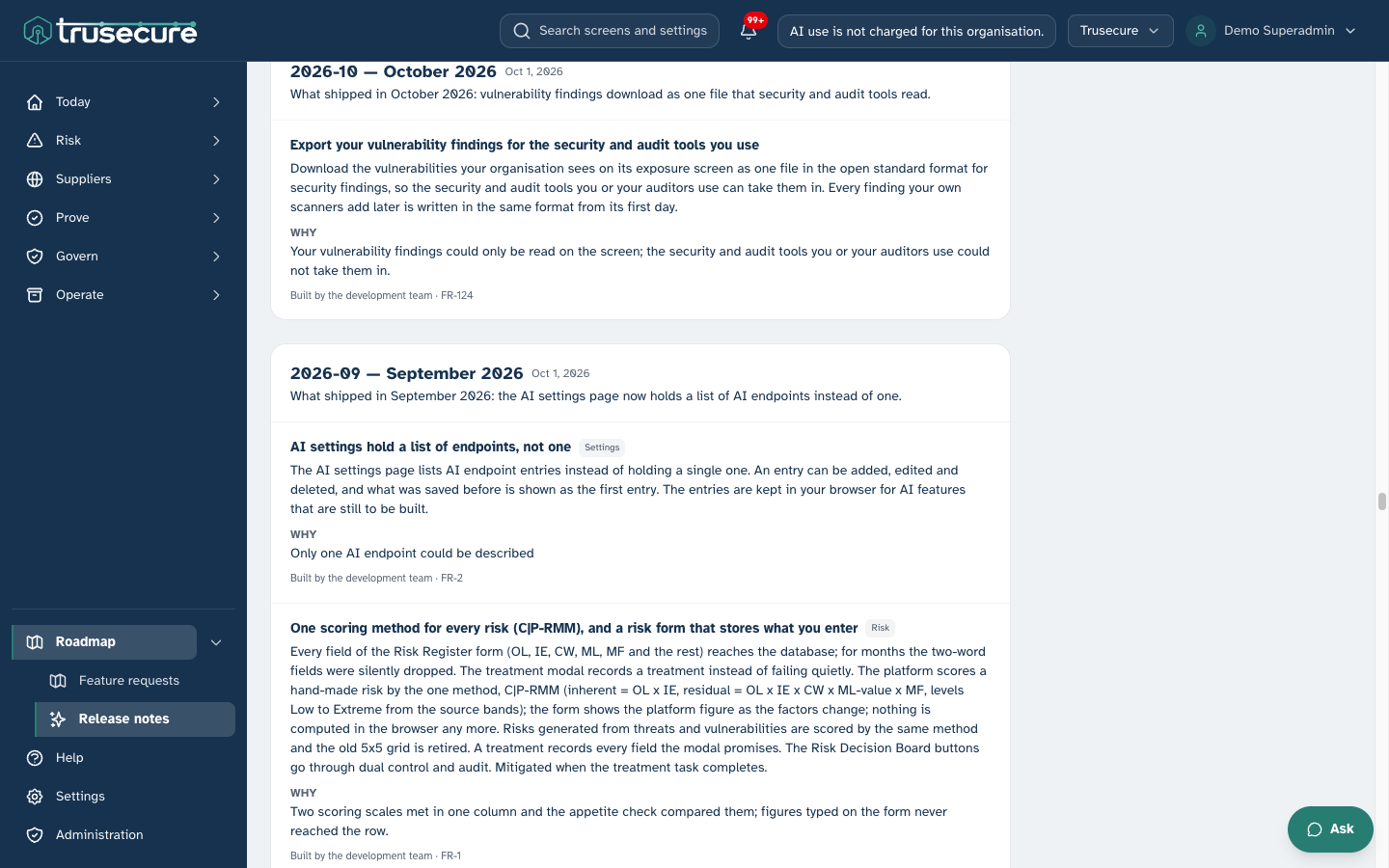
Every piece of work reaches the product with a release note. The note sits on the board beside the entry. You read the note where you read the entry. You see what a piece of work did before you turn to the next one. The notes keep their date, and the reference travels with them. A note from two years ago still names the same thing it named the day it shipped. That is the difference between a list of work and a record of it.
- The note says what changed, in the same words the entry uses.
- It carries the date, so you can place the work in your own history.
- It keeps the reference, so an old note still points at the same thing.
Start
Ask for what is missing
If the board is missing something you need, raise it and vote on what is already there. The same board decides what gets built next.