Security engines
Network intrusion detection
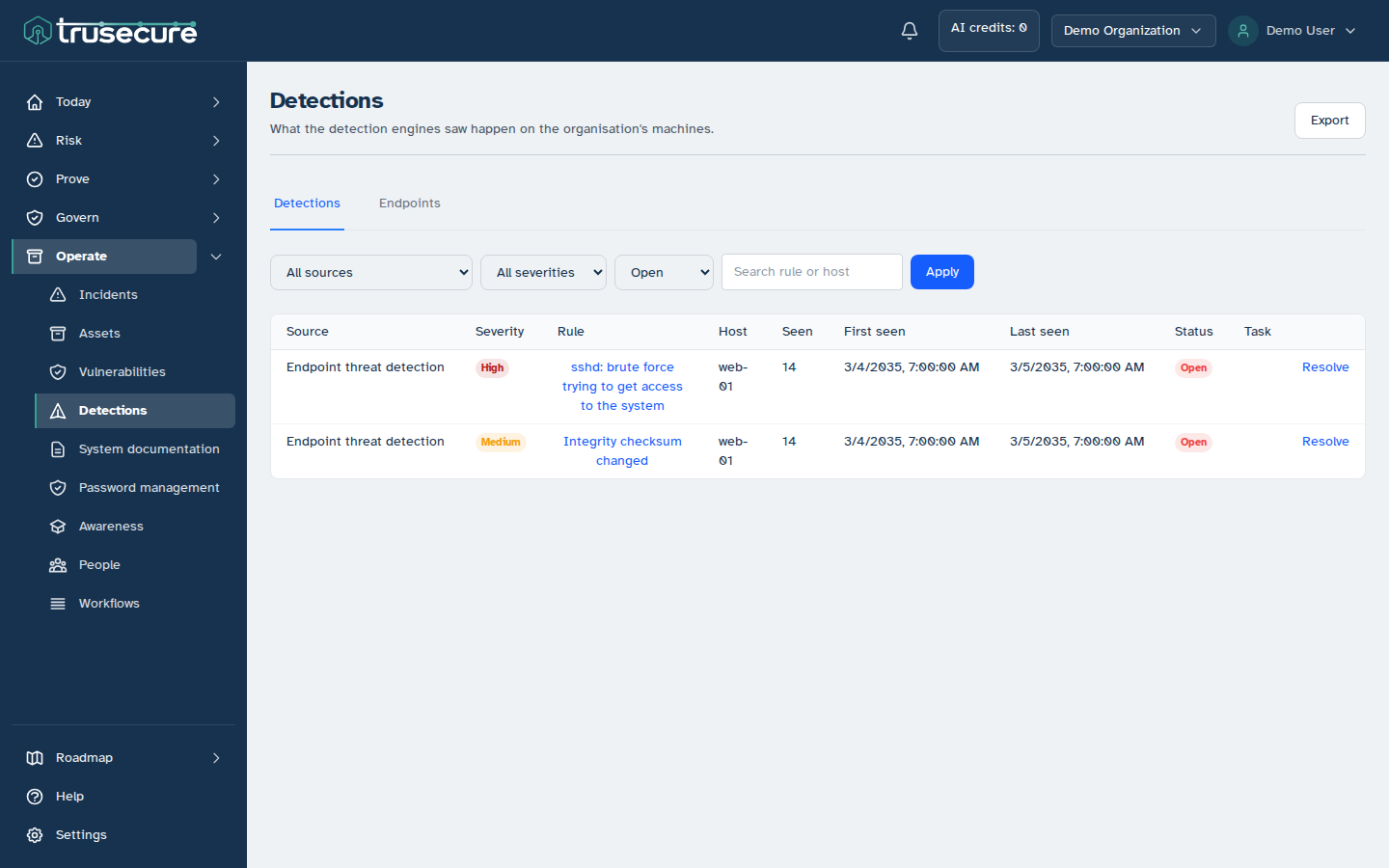
A detector on your own network, reading the traffic your mirror port already shows, recognising known attacks by their signature. Every match lands on your detections, beside the findings of your other engines.
- read an hour
1
The alerts are read into your detections every hour.
- severities on an alert
4
High, medium, low and informational.
- rules in the open rule set
50,000+
All of them alert rules, and the rules are updated daily.
What TruSecure does
Known attacks, found by their signature
The engine runs a detector beside your network and reads the traffic your mirror port already shows, so you give it nothing new. It recognises a known exploit, a known piece of malware calling out and a known scan, and puts each match on your detections. The tasks and the incident proposals that follow are raised as they are for every other detection.
The run
What an hourly read of the alerts does
The alerts are read every hour, and only while your approval for network monitoring holds.
| Step | What happens |
|---|---|
| Prepares the tool | TruSecure starts the detector on the machine of your network threat hunting sensor, reading the same mirror interface, with the daily rules update added. It stands in no traffic's path, so it only listens. |
| Reads | The alerts after the last succeeded read are asked in pages of 1,000, at most 100 pages a read, and a read that stops there goes on at the next. The date of the rules in use is kept with every read. |
| Holds the result | Nothing is written into the detector. Each match is kept as one finding, and only the signature, the number, the class, the severity, the time, the addresses and the ports are kept. No packet and no payload. |
| Records the run | The findings are kept in one go with their counts, and each one raises a critical task that opens the detection. |
Questions
Questions we are asked about network alerts
- What is kept of a match?
- Only the signature, the number, the class, the severity, the time, the addresses and the ports. No packet and no payload is kept, and the detector never blocks or changes traffic.
- What if the detector cannot be reached?
- The run says what went wrong in one sentence, the integration reads Error, and no finding changes. A detector that does not answer fails the read.
- Does it sit in the path of my traffic?
- No. It reads the same mirror interface your own sensor uses and stands in no traffic's path, so it only listens and never blocks.
- How current are the rules?
- The date of the rules in use is kept with every read, and the rules are updated daily. The open rule set holds more than fifty thousand alert rules.
Open source
This capability runs Suricata, an open-source project released under the GPL-2.0 licence.
Start
See what your traffic already shows
Tell us where your mirror port sits. We show you the known attacks your traffic already carries, and what each one would raise.